Plotting Prudence

A $200 computer can do almost everything that a $2,000 computer can do, yet it is one tenth of the price. A Toyota can do almost everything that a Ferrari can, but you can own seven fully loaded Camrys for the price of a 458 Italia. It’s true that a Ferrari outperforms a Camry in almost every area, but is that extra performance worth so much?

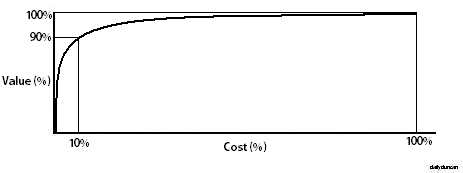
This phenomenon is present in every category, from studying for a test to cooking a meal. In anything which we invest time, energy or money to get a result, we will find that we get 90% of the value for the first 10% of the cost.

Of course, the value on this graph is in relation to functionality, not luxury or aesthetics. A painting which has received countless hours of detail is much more beautiful and meaningful than a doodle on a napkin, though they may depict the same scene. Likewise, a meal, when cooked with care for a loved one, conveys the appreciation and love not found in microwaving a frozen burrito. However, if you are going to make an investment or purchase for the sake of necessity or functionality, the efficient choice lies somewhere around the 10% mark.

E-Search

The Internet is a powerful source of information. No matter what the subject, you may surely find what you seek on the web. The most peculiar topics are likely to have a forum or entire web ring dedicated to their discussion. The strangest idea you every had probably has a website devoted to it.

The Internet has become increasingly trustworthy as a source of knowledge and advice. The average citizen no longer turns to newspapers, encyclopedias, textbooks or the elderly for information, instead favoring the touch of a key over a word from the wise. Whether you’re writing a paper, raising a child or buying a car, the Internet is likely the first and last place you will look for help.

Now whether or not you trust the Internet for advice on how raise your children is up to you, the real issue is what you say you are doing when you beseech the web for wisdom. Here is an example of how a typical conversation usually plays out:

“Scott, I think I’m going to buy a Ford Focus.”

“Why would you such a thing, Gary?”

“Well, I was doing some research the other day on Ford’s website and it said that the Focus has the best fuel economy in its class.”

“I can’t argue with the facts, Gary. If the research supports your decision, then I am obliged to concur.”

The problem here is obvious, Gary never did any research. Research is what scientists are doing when they discover new medicines, what biologists are doing when they embark on deep-sea explorations, what archaeologists are doing when they unearth dinosaur skeletons. Research is not when you type, “should i buy a ford focus plz?” on Yahoo and click the first link that shows up. Claiming that you have researched a subject that you merely read about online is a severe exaggeration, if not downright deception. People have devoted their entire lives to fields of study, often braving remote and hostile conditions for years, for the sake of research.

The word research conjures up ideas of devotion, nobility and discovery. There is nothing noble in reading a blog about cat ear medicine and no devotion or discovery in spending two minutes scrolling your mouse to find out how a light bulb works. Instead of misleading others by telling them that we have done research, let’s use a new word:

e-search. [ee-surch]

verb.

1. to use the Internet, or other electronic source, to acquire information.

-noun.

2. the quick and easy process of scanning the Internet for information on a given topic.

This word perfectly captures what you actually did to find out how to throw a frisbee extra far. You did an electronic search, nothing more. There was no critical thought or analysis, no experiments, no systematic investigation and no discovery. You typed a phrase on a keyboard, then read what someone else wrote, that’s it.

Eco-Track

One of the worst inventions in recent years has to be the Segway, a personal transportation device which uses gyrostabilizers and an electric motor to whisk pedestrians up and down the town. Besides the fact that the Segway accomplishes nothing that a bicycle or scooter cannot, no one in their right mind would spend upward of $5,000 for such gimmicky apparatus. In an age saturated with laziness and brimming with obeisity, people do not need another means to avoid physical activity. That is why many companies are now turning to HP (human-powered) technology in favor of electric devices. One of these devices is especially interesting, as it combines the health benefits of a treadmill workout with the modern sophistication of a Segway.

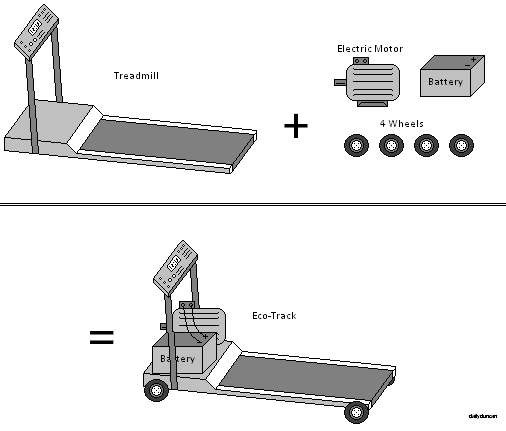
Now the future is one step closer, introducing the Eco-Track:

Take all the joy and satisfaction of physical exertion and put it together with hip, new-age technology and you get the Eco-Track. Who wouldn’t want to be seen moving down the street by the power of their own legs on this snazzy gadget?

The Eco-Track uses an electric motor, powered by a battery which stores the energy generated from the track; so simple, it’s brilliant. The speed of the Eco-Track ranges from a comfortable walk to a brisk jog, depending on what the rider prefers. If you want to increase the speed, simply walk faster and if you want to stop, just stand still.

Obviously, this invention is a forgery intended to point out the inherent stupidity of having a machine walk for you. Instead of inventing contraptions which separate physical activity from transportation, we should be seeking to unite them. We can start by taking things away from people and forcing them to use their bodies. No more Segways, no more forklifts, no more Zero-Point Energy Field Manipulators and no more crutches.

Clearing Up Cleansers

When something is dirty and we want it to be clean, soap is a good choice. Deciding which soap to use makes it a bit trickier. There’s hand soap, dish soap, shampoo, body wash, facial cleansers, car wash, kitchen and bathroom cleaner, hand sanitizer – the list goes on and on. Some of these soaps clearly have special purposes, for example, we need a degreaser for dishes, while a stain remover is best for clothing and upholstery. But is stain removal really a bad thing to have in our dish soap? Is a degreasing agent out of place in body wash? Once we start to believe the lie, that we really need all these different soaps, our life becomes complicated by the myriad of choices, but soon we will see there can be only one.

A great deal of soap diversification is due to the cleanser industry’s complex marketing strategy. They want us to buy the latest product specifically designed to help make our life easier. This seems reasonable, until one day we open our cupboard and find it’s full of Tide; we open the fridge to grab some milk and realize we’re holding Mr. Clean and when we try to start our car we discover that the gas tank is full of windshield wiper fluid. An interesting fact, windshield wiper fluid was recently ranked as the most useless among marketed consumer soaps. Anyway, we need to get back to the basics; we need to know what it means to be clean.

Urbandictionary.com defines clean this way:

  1. Having stopped taking drugs.
  2. Something nice or tight.

In light of these insightful definitions we can conclude that something is clean when there is no visible, tangible or smellable residue and when bacteria levels are within a safe range. When we view cleanliness from this perspective, it begs the question, can’t there just be one soap?

Why must men and women bathe with different bubbles? Their bodies can’t be so different that they require alternate chemical mixtures to remove dirt from their skin and hair. And why can’t we wash our hair with dish soap? Everyone’s hair should be clean enough to eat off. The idea that our skin requires a certain form of soap makes no sense and, to crown their absurdity, soap companies would have us believe that certain parts of our body require different cleansers, as if the skin on our face shares nothing in common with the rest of our body. Unfortunately, as each new detergent is dispensed upon the public’s hands, social pressures ensure that no one dares break the lathery laws of soapery.

One can only imagine what’s next for soap. Certain sources cite Rump Rinse as the next big thing, a cleanser specifically designed for derriere care. After all, our bottom is a unique and special area, so it could require special treatment. Soon it will be unthinkable that body wash could service our rear end, and those who use these suds on their scalp will likely be called butt-heads.

Faux Jock

A faux jock is a male human who, by his physique and aggression, seems athletic, but only imbibes these traits for social purposes. The faux jock is identified by a few key characteristics:

  1. A disproportionately overdeveloped upper body.
  2. Readiness to engage in fisticuffs over trivial matters.
  3. A unique grip of cellular phones.

We will be focusing on the third identifier since the other two are fairly straightforward. The following step-by-step instructions will take you from ring to faux jock grip.

To begin, simply wait until your phone rings. While you are waiting you may take your phone from your pocket and send an insulting text message to a friend. Once the ringing begins you may answer or, if the caller is a girl, notify your peers that the call is, in fact, from a female. It also helps if you have the latest club song as your ringtone (the volume at maximum, of course).

Once the call is accepted, elevate the elbow connected to your grip hand as to make yourself appear larger. This is a common behavior exhibited by certain species of birds and reptiles to attract mates and intimidate competition. It also gives people a better view of your biceps. Ideally, the elbow should be raised high enough to give you a level surface on the outside of your forearm.

With the phone resting in a nearly open palm, use your index finger to firmly plant the upper part of the phone to your ear. You do not want to be seen as merely supporting the phone with your hand, but controlling it. You are the boss of the phone, not the other way around.

Once you’ve engaged in conversation do not yell but be sure that everyone nearby can hear everything you’re saying. This is another common demonstration in the animal kingdom – emitting loud noises to alert others of your presence. You may now roam the area, making sure to keep your torso upright and muscles flexed.

After the conversation is finished put your phone away and return to your group. It is now customary to downplay your enthusiasm, referring to the conversation or caller as a nuisance.

Now that you can recognize the faux jock grip be sure to conceal your laughter; the faux jock will charge at even the slightest threat to his pride.

Brotherhood of Nod

In the daily grind of traffic, there is a peculiar occurrence which many have witnessed but few understand. Those who have driven any sort of atypical vehicle, like a motorcycle, hot rod or commercial truck, know it well: the nod.

The nod is a momentary expression shared between two individuals driving vehicles that are similar in size, shape and wheel count. The nod usually occurs just before the two drivers pass each other while traveling in opposing directions. Once the drivers notice each other, in that moment, without any prior relationship or communication, a kinship is shared. As the machines pass, the drivers acknowledge each other with a subtle physical gesture. The gesture is often a slight nod, but it can also take the form of a tip of the hat or a wave (partial or full-fingered). This brief moment of comradery may seem like a shallow, compulsory custom, and it is.

After all, what could two motorcycle-riding strangers have in common with each other, other than a fondness for two-wheeled automobility? What secret knowledge could be shared between truckers, aside from a common vocation? Surely all who drive similar vehicles or work in similar industries needn’t nod at every encounter. But if the requirements for this practice are so minimal, then we should nod to our coworkers, family members, friends, schoolmates, we should nod to those who look like us, dress like us, are a similar age as us, we should nod to those who enjoy similar activities as us, eat the same food as us and think the same thoughts as us.

And why should we only nod while driving? It would make more sense to acknowledge others no matter where we are or what we’re doing. However, nodding at every opportunity to everyone with whom we share something in common would obviously be irritating and impractical. But if the nod is so clearly meaningless when expressed in such circumstances, then what meaning could it possibly have in its current state? If we could sum up this expression in a single statement, it would probably be this:

We are driving similar vehicles.

The next time someone gives you the nod, imagine that phrase and keep your head steady and hands firmly fastened to the wheel.

Best Wishes

When staying up too late with friends, conversation tends to drift past the realm of relevance into the imaginary and supernatural. One such conversation involves the What Would You Wish For? scenario, in which the subject is called to answer what they would request from a genie who could grant any wish.

The scenario varies slightly depending on whether the genie abides by single wish or tri-wish regulations. Most top wish analysts agree that three wishes would seem unnecessary, as the wisher’s first demand should be comprehensive and explicit enough to grant all of the desired fortune, fame and power at once. In other words, three wishes is for people who don’t know how to wish.

Before we move on to wish design, we should cover some basic rules that might be enforced by genies if they were real and cared about regulation.

  • Rule #1: The wisher may not wish for more wishes, more genies, a do-over or to see the outcome of a wish prior to wishing.
  • Rule #2: The wisher may not make sub-wishes inside of a single wish by using conjunctions such as and, with or plus.
  • Rule #3: The wisher may not wish to ascend beyond the scope of human understanding. For example, the request “I wish to be God” would be denied due to the terrifying cosmic ramifications of said wish.
  • Rule #4: When the wisher is not explicit in a demand, the genie is to request additional information. If none is given, the wish shall be granted to the best of the genie’s understanding. For example, a wisher who requests “to have magical powers like Gandalf” is implying that they want the power of reincarnation, telekinesis, beard, etc.
  • Rule #5: The wisher may not wish the genie free. As alluded to in Rule #1, genies may not be the target of wishes. In addition, a wish granted by a free genie holds no power, thus resulting in a paradoxical wish-loop.

Now that we’ve covered some basic rules, we shall answer once and for all what is the best wish?

If we were to choose based which wish is most popular, we might end up with unlimited money, immortality, the ability to fly, invisibility or something equally shortsighted. Thankfully this process isn’t democratic, otherwise we might end up with something as meaningless as a wish for change.

If we chose based on power, then the idea of infinite wealth is out, since money is only valuable because of its scarcity and can only be used to execute limited corporeal commands. Wishing for power, however, comes with many dangerous consequences. For example, wishing for the ability to reshape reality would likely put an end to the world as we know it. The laws of physics would be overruled by the will of a flawed, selfish creature, and it wouldn’t be long before the Earth was uninhabitable because the wisher wanted the sky to be made of bubblegum.

The best wish is one that combines power with practicality and wealth with wisdom. We do not wish to reshape the universe, neither do we wish to merely vacation in Hawaii and drive a Ferrari. What could be more desirable than power and more precious than gold?

Knowledge.

The best wish is to wish for knowledge. More specifically, to wish for the ability to know anything that you want to know. The scope of this wish ranges from the most crucial and decisive questions about our existence to the mundane and inconsequential, from the origin of the universe to the location of the TV remote, from the truth about whether we are alone in the universe to the winning lotto numbers. It satisfies the deepest existential, emotional, physical and spiritual desires of our heart. To answer all things – it completes a human being.

This wish does not come risk free. Since everyone is closed-minded to some degree, there may be answers that you would not like or even reject. Finding out there is or isn’t a God or that Coke is actually better or worse than Pepsi is a frightening thought. It is possible that after shattering your philosophical framework a few times, you might be able to look beyond these constrictions and enjoy some level of peace. It’s also possible that this knowledge would become a burden, in which case you could just choose to know how to not be burdened by the knowledge or to know how to unknow it.

If you ever encounter a genie who will grant you one wish, wish for knowledge. In the mean time read a book.

Smell Particles

Olfaction is the means by which vertebrates sense whether or not something is delicious. Before we eat any mysterious food, we usually smell it to make sure that it’s not something we won’t enjoy. Some things have an appealing smell, like flowers, but their aroma doesn’t make us want to eat them. This is an obvious trick that nature uses to get us to eat inedible things. Mastering the ability to discern which smells indicate edibility is a lifelong process of trial and error.

There are also undesirable smells, like that of decaying flesh, which discourage us from ingesting their sources. What’s interesting about smelling is that it doesn’t actually prevent disgusting things from entering our body. Think about it, how could we detect the scent of rotten meat if no part of it was in contact with us?

Some have proposed that the particles which we detect with our noses are somehow different from the ones that actually comprise the source. These imaginary devices are called smell particles, and their invention is solely meant to conceal the fact that when we smell something, tiny pieces of that thing are entering our body. To more accurately understand olfactory mechanics, think of smelling as merely tasting from a distance. This might not seem like an important revelation, but the consequences can be alarming.

The thought of flower particles wafting into our nostrils likely won’t upset anyone, but when we imagine less pleasant fragrances, like those found in outhouses or garbage dumps, the gravity of the situation takes hold. Whenever we smell a dump, whatever kind of dump, particles of excrement and refuse are going inside of us. There is no enchanted smell particle that protects us from nasally ingesting these awful things, a fact proven by the damage caused by sniffing toxic chemicals. Thankfully, many of these potentially harmful particles are caught in our nasal passages before reaching vital areas. This realization, combined with cultural condemnation, should ensure that booger-eating is eradicated.

The use of air fresheners is a popular solution to stinky situations, but while they claim to neutralize odors, they only ensure that we are inhaling the undesirable particles as well as a concoction of unnatural chemicals. One popular brand contends that its product actually eliminates odors rather than covering them up. The company recently released a line of products that are completely odorless, which they see as proof of their product’s neutralizing powers. As the commercials illustrate, these products are able to make even the most filthy, unsanitary space smell fresh and clean. But even if an air freshener could completely remove all odors from the air, it doesn’t address the cause of such smells.

Things stink because they’re dirty, and dirty things need to be cleaned. When the garbage can stinks, it’s time to empty it; when the cat litter is foul, it’s time to change it, and when our body reeks of sweat, it’s time to bathe. The problem with a rotten smell is not our ability to detect it, but that something is rotten.

The reason people don’t live in filth is not because of the smell; it’s because humans have a disdain for unclean things. Although our ideas of cleanliness may differ, most would agree that it is not good to let things rot or decay. Our sense of smell is a tool that we use to determine whether or not something is clean, which also helps to determine edibility. By using air fresheners to mask or eliminate odors, we are effectively removing our capacity to detect uncleanliness through olfaction – as much a solution as plugging our nose.

But unlike plugging our nose, air fresheners don’t prevent us from taking particles of toxic or filthy things into our bodies. Even the air fresheners that claim to eliminate odor don’t actually destroy these buoyant fragments of filth, but merely inhibit our ability to sense them. Also, aside from distorting our understanding of cleanliness, these products discourage us from obeying one of the most fundamental childhood lessons: cleaning up after ourselves.

Of course, most of us still recognize when something is dirty, for we can usually see the evidence. But perhaps one day air freshener companies will release a set of goggles that make dirt and messes invisible, thus altering our reality to a more pleasant state. After all, it seems as though we are as much concerned with the perception of cleanliness as cleanliness itself. Or, if we can’t wait for such technology, we could merely make do with something more primitive:

Be careful, little nose, what you smell.
Aged Lamb

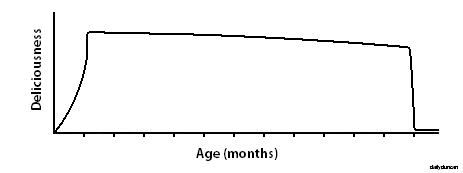
Many North Americans enjoy the taste of lamb. Maybe it tastes so good because lambs are innocent and pure – they haven’t tasted the harsh cruelties of life – or perhaps because the meat hasn’t been sitting out in a field. Whatever the case, we can’t get enough roasted lamb, rack of lamb, lamb chops, lamb shanks or lamb tacos.

Everyone knows that lamb is an acceptable choice of meat that can be found at any supermarket, but why don’t we see mutton along side it? We eat both veal and beef, but in the world of sheep only the young are fit to be devoured, as if the meat becomes garbage once the lamb has a birthday.

A lamb becomes a sheep after one year and its meat can no longer be sold as lamb, instead going by the name hogget; after two years the meat is known as mutton. Obviously the quality of the meat does not immediately disintegrate once the name changes, so there must be another reason for the rejection of this legitimate food source. The answer is found in the question, “Why don’t people eat mutton?” Would you want to eat something called mutton? The word begins with derogatory slang for a dog and makes us think of dark, stringy flesh that smacks of mud and ash. Even hogget, which is not as familiar a term, would cause the curious to cringe after simply reading the label. So what’s the solution?

From now on the meat of any sheep past the age of twelve months shall be known as aged lamb. People like aged things, like wine and cheese, so they will be innately attracted to the idea of aged lamb. It offers the perception of a more robust, chiseled flavor, catering to those of us who prefer more refined cuisine. Now in addition to wearing their hair on our bodies and using their guts for tennis rackets, we can now fill our stomachs with our puffy, bleating friends.

Stop letting sheep off the meat hook and eat aged lamb.